Wednesday, April 11, 2018

Cancer and the Lost Voice

How to Give Up a Voice



When the internet became a growing thing in schools, often early adopters would say things like, “Students will have a voice in their schools and communities.” Everyone cheered for the idea. Fast forward to now, and it seems everyone has a voice about something or another these days. It often feels stifling to try and get your voice in at all, much less get it in and have it mean something amongst the noise. Even in areas of faith, “Type Amen,” “Share if you want God to bless you,” “Pass this image without liking, and the devil wins.”, Etc. How do you even feel like God can hear you? I am often reminded, and at times often think like Zacchaeus, needing to climb the sycamore to ensure he could see Jesus amongst the crowds.  This is not just something we do in faith, but daily and a lifetime of being under the radar. If you’ve spent a while in the hospital or face chronic illness, you understand what losing your voice is like.

Training to Be Voiceless


Many people have no problem having a booming voice in any situation. From an early age that they have been told they matter and furthermore, their opinion matters. A great example is the that instead of calling Instagram and YouTube stars what they are, pseudo-celebrities, they have been given the title of “Social Media Influencer” because their opinions matter and they get to tell others what to think as well. When the rise of the #MeToo Movement was still in the headlines, I read an article about Time Magazine’s choice to include Taylor Swift on their cover highlighting women that spoke out against sexual misconduct. The writer, also a woman, condemned Swift as not being a good enough woman for the simple fact that Swift had not openly and publicly taken a stand or commented on the current political administration with as many young people that follow her. Personally, I was appalled to think that one woman would belittle another for not doing enough in their eyes and also that Swift possibly had hoped not to alienate fans regardless of her political views. This article stuck with me because it did nothing for my opinion on Taylor Swift, to whom I have little to no opinion on, but did everything on my opinion of myself. This article told me if a personality as big as Taylor Swift can be brought down for either using or not using her voice, what possibility would little me have of having a voice that matters.

Accepting being silenced is something I experienced in all facets of my life. Growing up, I was bullied. Kids found one reason or another to give me crap, I sought help, and it didn’t change. My voice didn’t matter. Being good at something, like art, then getting passed up over and over because a talented arts program required daytime volunteer commitments from two working parents unable to miss work to serve Kool-Aid. My voice didn’t matter. A fifth-grade teacher that told my parents she would refuse to teach me if they didn’t get me on pills because I was an overactive child. My voice was too much to hear (thankfully my parents did not agree, and another teacher, capable of teaching me, took me on). Various romantic relationships where I accepted being talked down to and always giving in as acts of chivalry. My wants did not matter. Parents of women I loved actively plotting the end of our relationship, by forcing their daughter to go on dates with guys they selected, because I wasn’t the person the envisioned the daughter being with. Those same parents eavesdropping on a private conversation between two adults of the age of 21 speaking about waiting until marriage, and then perverting that conversation to mean we were plotting getting pregnant, efficiently forcing their daughter to no longer see me.  I didn’t matter.

The point is, this is the kind of conditioning people continuously undergo such treatment, which leads us to believe things about ourselves for the rest of our lives. Before the communication age, when people dealt with these types of problems, they were told to suck it up and get over it. Sadly enough, there are still a lot of people out there that still want everyone to “Man Up!” Let me tell you about a cross-section of Americans that have problems and were just told to “Man Up!”, Combat Veterans. An astonishing 45%-50% of Americas homeless are made up of combat veterans that faced trouble coping with what they have seen and were either driven out of their homes for mental health reasons or turned to drugs as a coping mechanism. We as a society need to reconsider the “Man Up” mentality.


Speaking for Your Health – In the Hospital


Two instances in my life recently where my feelings of being voiceless. Both of these times have culminated in hardship and breaking on my part. I looked upon the precipice of my pain tolerance and mental limit and pushed beyond it. I didn’t go kicking and screaming; I went reluctant and silent. These occurrences brought on life alterations that may have been avoided, if only I had my voice to speak.
In the hospital, with my cancer recurrence, so much trauma happened to my body as well as my psyche that I walked away being classified as having PTSD. The first significant event was placing my Central Venous Catheter. I know I have mentioned this. Nurses spent a good hour and a half to two hours, digging a needle in my chest looking for an artery they could not get to because I was asked to fast and was severely dehydrated.  Because the process requires my chest to be as flat as possible my face was turned as far away from the nurses as possible. I hurt, more than I can even recall. So much so that I broke my top left wisdom tooth from clenching my jaw. Every time they would start a nurse again, up to four, would say “Mr. Hernandez, I am (name) I am going to give it a try ok?” All I could ever muster was a nod, and they went to work. You see, I felt that if I had spoken up, the nurse would have been agitated and hurt me more being careless. I also kept hoping it would just end. It wasn’t until the head nurse of the department came to give it a try asked if I was ok with her trying she heard me whimper as I nodded. She asked me to look at her, and I can only imagine what she saw. My face was wet with tears, my mouth had a little blood, and my jaws were beginning to get puffy from clenching. She immediately called for a full stop and ordered everyone out. She returned me to Tara to continue waiting why she set up another appointment with a doctor, placing the CVC with a live X-Ray. That wasn’t much better, I was still not allowed to eat, I waited and finally had the procedure under the machine what would burn my flesh permanently in three spots on my chest. Still there and still itches daily. I got to eat a peanut butter cracker a nurse gave me from her own lunch around 6:30 p.m. waiting to find my infusion room. Arriving at the infusion Tara and I become informed that we would be checking in the hospital for the week, something no one had ever discussed with us. Neither of us could fight it because treatment wouldn’t have started until the doctor was back in the morning. Tara was also trying to speed up my check in so I might get food and drink as well as real rest.
My treatments didn’t go as well as I had hoped either. Hospital policy changes left me retching a good deal of food waiting on medicine or dealing with a migraine waiting on simple Tylenol. The floor LPN deemed my bloodwork not good enough most weeks when the attending physicians I had were satisfied with the same reading. Instead, she was always trying to keep me another day pumping me with gaseous fluids attempting to alkalize my kidneys. This inflation would later lead me to gain an extra 20 pounds, which thankfully I have now lost. Tara would fight with nurses over my need to get out of the room as much as possible; if it weren’t for her voice, I would have just laid there, lifeless and miserable.
My biggest problem with M.D. Anderson now is that I am just a number there. While I receive excellent healthcare medically, there is no personalization in it whatsoever. I have even seen this in my oncologist whom I have once cherished. Therefore, Tara and I scoured the area begging a local oncologist to take my case. Unfortunately, they all gave the same answer. No one in our area is trained to provide the regiment needed to fight my particular cancer, and M.D. Anderson is my only option. Again, what little voice I tried to use, was snuffed out.


Speaking for Your Health – In the Workplace


I realize now I set myself up for failure and abuse when I returned to work after the tumor and lymph node resection. My six weeks of bedrest and recovery was boiled down to two. In the attempt to get back to my students, I began going back daily because my effort to work from home always ended with someone asking if I could come by in person and instead of saying no, I went. So I tried to appear strong and went back to work, getting up at regular intervals to empty my Jackson-Pratt drain of blood from the empty lymphatic area. Why did I do such a thing? Because in my mind, saying, “No I need not work,” was an admittance of being weak and I didn’t want to disappoint anyone. Little did I know that I was setting myself up for a breaking point.
When I returned, I asked the head boss for help because I did not have the energy to continue to teach as well as take on all of my other responsibilities. I had already been unable to visit both campuses on a regular basis and had someone take over part of my job there. The solution, however, was to see if someone else could take on my class, however that is the part I didn’t want to lose, so my ask had been put off.
As my body became more and more tired, and the lymphedema took firm hold, I began missing work and being late from being unable to use my leg immediately every morning. On top of that, I started having more appointments for physical therapy as well as mental health which was required by my oncologist after my recurrence treatments. Even though I voiced my concerns more, additional task became my responsibility in an effort to alleviate stress from others deemed more necessary to the day today. My performance had dropped, I knew it, and I know it was apparent to some. In my performance review, I relayed to the head boss that my department needed another person to keep going. I admitted to him that I could no longer work as I had before even if I tried. With all I was responsible for, my typical day went something like this. Get up and go to work until 4 pm, go home make dinner and spend time with Tara; once Tara was in bed around 9 pm I would start my computer up and work on various things for work sometimes until 3 am. We agreed that I should not work late from home and do what I can to utilize my time in the office. A promised solution never came.
This year before my departure, still without extra help, more tasks were being asked of me. One department complained because I didn’t make an effort to stay at evening events sometimes until 9:30 pm. I did a few times in hopes of appeasing. Board members saw it fit to add work to my already full load, even going as far as to call me while I was at home, on weekends, and showing up unscheduled in my office. I was expected to drop everything for them. Projects I had done in the past that I enjoyed were either needing outsourcing or put on the back burner.
Eventually, I could no longer keep up. My inability to focus all my energy on other departments’ projects was not met with understanding. Instead, it was met with bullying from adults, claiming to be professionals. Whining to clients, other bosses and messaging whole groups via text on weekends to complain about what they perceived as my “unwillingness to help.” Board members approached me when out with Tara asking for this and that, and I sat there and took it all. My only ally was my immediate supervisor who had also asked for another department member, attempted to quell the others, and stood up for me when I was attacked. Everyone who could have helped alleviate any of the wrongs was silent.
With the stressors reaching a new ceiling, I broke just before Thanksgiving while at M.D. Anderson being physically hurt which resulted in a full-blown and very public panic attack. After pleading to go home, they agreed on the condition I do not return to work until after the Thanksgiving holiday, basically a week and a half. My grandfather passed away that Thanksgiving Day. At his funeral, I prayed for his council, and I felt, spoken in my heart, that I needed to take full disability. My only act of using my voice was to say goodbye to those I loved dearly I worked with, to tell students I had mentored that all would be well.

My Voice Now


So where does this leave me? The ability to use my voice in profound ways. I want to develop a website where I can be a voice for good; I, however, have not done this because it will cost some funds and as usual I doubt anyone cares about my voice.

If I am capable, I want to voice to the hospital that I am as much in need of empathetic care as I am medical. I am allowing you to do things to my body, at least listen to my concerns and what I know about my own body before we go forward. Doctors wanting their patients to keep fighting should make them feel like their fight matters to you and your staff.

To the school, I want to say to those who hurt me and pushed me out; I forgive you even though I am still angry. Try to do better, try to be better examples of what the students hope adult life can be. Too often I have heard, “I thought it got better once you were older? What’s the point then?” Regardless of how you try to hide it, they all see it. Don’t perpetuate the cycle of hurt, creating more adult bullies and thus creating more hate and pain. I felt voiceless because I was not treated as an equal. Especially to the older crowd, I was never given your respect because you only saw me as some kid. You asked why some of the students didn’t respect me? Well, the answer is you never showed them that they should. It was not because I tried to show kindness to them, to relate to them and make them comfortable coming to those they should when things were dire.

To those I care for and left behind, I am sorry I left you. Know that you have been part of my survival and I can not thank you enough for that. I want to visit you, but there is some difficulty disassociating and facing those who hurt me with calm. To the students still there, as well as those from the previous year. I am sorry I had to let you down. I am sorry that I was unable to finish the projects important to you because I was not able to make them a priority. They were important to me because every one of you has been important to me.


Before anyone responds, especially if this finds its way to those that hurt me, do not attempt to rationalize or explain your actions. You do not get to decide how someone feels about your efforts. Make it a priority to take what I have said here and use your voice. Use it for yourself. Many of us, myself included have no problem standing up for others, but when it comes to ourselves, we fail, expecting someone like us to come to our rescue. Don’t lose your voice in anything you do.

Wednesday, March 7, 2018

Cancer and the D-Word

The "D" Word

A well respected and wise educator once said to me, “Sometimes there is the need to put words to paper. It makes them more real even if you do nothing with them.” A little while later, in a workshop, the same person leads a group of educators to the conclusion of what should happen to those real words after being put to paper. The finding, as I can best summarize, that as writers we tend to want to keep our words on the paper to ourselves, however, it brings more significant value to our understanding of those words to let them go out into the universe.  Furthermore, in doing so, we have the unique ability to unknowingly touch the lives of others we didn’t know may have needed them.  So here I am, putting my words to a medium and then letting them go out into the universe.


I am disabled. Admitting disability has been difficult to say aloud or write out because I have refused to believe it. I have been of the mindset that I can overcome any obstacle with sheer willpower. From a young age it was ingrained in me that anything I get, I earn through hard work. So to give in to my weak flesh is something I feel shame about doing. Even the insurance companies and such have me feel ashamed of it as if I am making it all up.


My most significant hurdle it turns out is the negative beliefs I have about being called disabled over the proof and science behind it. Much like a flat-earther, science has no place in a mind made up. The part of the brain where belief resides doesn’t care if the same brain is signaling pain regularly to a missing extremity. It doesn’t bother that the same brain is sending distress triggers from a collection of random sounds, it doesn’t bother that the nerves surrounding a place where lymph nodes once resided flare up with tension. Why should I be allowed not to work and make things difficult financially? Why should I concentrate on my health when so many others are unable to? Why should I receive assistance when there are others who take advantage of the system?

So This is Me


The answer to all those questions? I am disabled. I am slowly coming to terms with it. It helped after being haggled by insurance companies that according to the government standards for disability I meet over seven of their requirements. It helps to come to terms with is talking to those around me. I have been shutting myself in at home of my own accord because I have it in my head that if I am well enough to go to the store or the lakefront I should be well enough to work. However, it is not the same. I can stop those kinds of things whenever I please. A job would be long hours of standing, sitting, walking, concentrating, etc. that I am no longer able to do.

So this is me, not asking for sympathy, not looking for justification. This is me admitting on paper, and out into the universe...

I am disabled


Sunday, December 10, 2017

Cancer and the Chapter's End

Goodbye CES


This past week, I said goodbye to Christ Episcopal as my place of employ for seven years. This was not a decision I came to quickly but one that I have wrestled with and fought for a while.

In short, while CES has granted me so much help in the way of taking care of myself with my cancer with time off for test and sick days; we reached a point where they could not provide the support I need in the office to keep my physical and mental health where it needed to be.


Not going to lie, saying goodbye to the place I have called home for close to a decade hurt a lot. Since after my recurrence in 2015, my doctor has asked that I consider permanent disability for numerous reasons. Reasons I thought I could fight like always. However, the workload kept growing, and my body could no longer handle staying up until 2 a.m. to finish projects for work. I asked for help personally and through my superior but CES's status as a non-profit school makes it hard in obtaining the personnel needed. After much fighting, multiple breaking points, and clawing at the bit I was faced with my decision.

Last summer I had a scare at the end of school in which a mass had been found. Unfortunately, in a person which cancer has metastasized, any mass has the potential to become an aggressive tumor. What makes it easier for these masses to develop you ask? Stress. Anyone that has seen a school work knows that the end of the year is stressful for all present. This year as we took one more and more responsibilities in my department that stress was reaching paramount level. 

I had taken a short respite to do some soul searching for my next step before Thanksgiving. On Thanksgiving Day, we lost my grandfather. In my goodbyes to him, I heard him urging me to take care of myself and make the most of my time left on earth. With that, I made the final decision to remove myself from my current situation and focus on my health. 

It is going to be a hard transition to permanent disability. This first week I always feel like I am missing something every evening. The financial burden will be one Tara, and I will need to face, but we've gotten through worse. I hope to accomplish so much in an effort to prolong what life I have and make the most of it. It is difficult to see that as a goal. I am having trouble seeing this step as a stepping stone and not giving up. God's Will I have the grace to endure.

As I said, it hurt to say goodbye. I hated feeling like I was abandoning the students that looked up to me. I hated leaving my office team which never had a dull moment. I hated separating myself from my fellow teachers I have learned so much from. I hated saying goodbye, but my wellbeing needed to. 

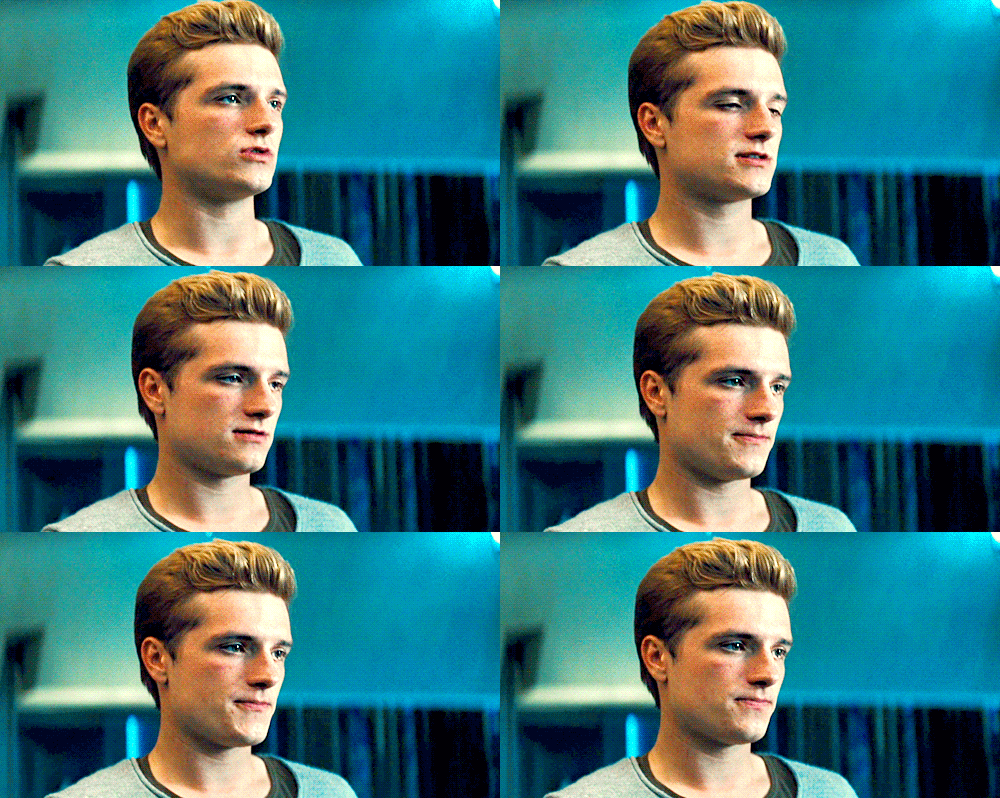
I still hope to come around. I have students I need to see graduate. I have lifelong friends I will visit at their job. I have CES events I want to share with my niece very soon. Troy Bolton said it best...


Saturday, May 27, 2017

Cancer and the Hug

What's in a hug?


Recently the seniors from the school I teach and work for graduated. After the ceremony, while congratulating everyone and making my way through alumni and current students, one of the graduates stopped me. She said,  "I need to give you a hug goodbye." I happily obliged, congratulated her and told her to keep in touch. I slipped out shortly after but thought about the hug because it reminded me of my first year at the school. At one of the very first dances I attended to photograph, the same young lady hugged me to thank me for being there and even let me be embarrassing and dance. It took me by surprise because it was unexpected and very sweet, but after knowing this student since 7th grade now, she is just a sweet person. Each hug had been a moment of comfort, a comforting welcome for me and a comforting goodbye for her, it all meant a lot to me. It also led me to think about another time a hug from someone seemingly random brought me more comfort than I'd ever know.

No Touchy


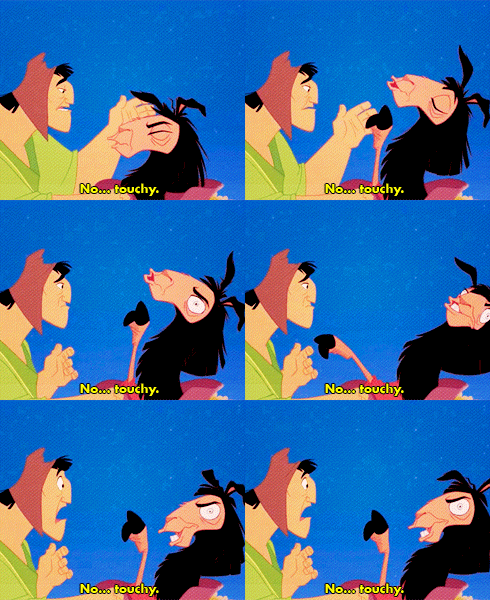
It's just a hug, why the big deal? Well, I will fill you in on my introverted side. I do not like being touched by people I am not comfortable with. I like getting massages, but I generally have a mini anxiety attack before I go because I know some stranger will be touching me. It is why no matter how long my hair gets I will only allow two people cut my hair.  It's why when anyone I don;t know get's remotely close to me in public I hold on to my personal items in a very strange stance. I often appear rude because I don't always shake hands and I sure as heck don't do that southern kiss on the cheek thing with most women I meet.
This condition, I guess we'll call it, comes from being bullied growing up. Being physically bullied means being touched by those you don't trust brings discomfort and pain. This childhood state carried over into adulthood, especially after being diagnosed with cancer when being touched by a new doctor or nurse meant more physical pain. I even went through an episode after my second recurrence where I wouldn't let anyone except Tara touch me because of the pain caused by nurses digging around in my chest for a few hours without any anesthetic.
So to find comfort in the embrace of a stranger in the hospital was a big deal for me.

Melissa


The morning of my amputation was tense for everyone. A lot of negativity led up to it and the morning was no different. Tara had started a new job that same day after being let go from her previous place of employment so she couldn't be with me. My dad driving me to the hospital was in severe road rage mode. My mother couldn't even look at me because it broke her heart. My brother called me on the ride there, begging me not to go through with the amputation. It seemed like everything was happening around me and I was watching it all.
In the chaos of heading to check in for surgery at 5:30 a.m. we passed by the staff elevator. It opened right when we walked by, and my eye was caught on the bright green bandana contrasted against the gray scrubs and lab coats of the staff, green also happens to be my favorite color. The bandanna sat atop the dark hair of a young lady with a bright smile and cheery demeanor. It was infectious, I smiled even when I should have thought to have nothing to smile about and went about checking in.
After being called back, the calm I had prepared myself for quickly turned to chaos. I was poked and prodded, asked over 100 questions and I began to worry. I kept trying to close my eyes to make time pass faster and get it over with. Then the anesthesiologist came in and said, "We'd like to give you an epidural to alleviate the shock to your nerves from amputation." I promptly asked, "Is it going to hurt a lot." To which he responded, "Well there is some slight discomfort when it first goes in." Which we call know is doctor code for, "Yes prepare yourself for some real pain."
I panicked and asked to decline. He left and in return walked in the green bandana. The same smiling face from earlier introduced herself as Melissa. Melissa was clearly sent in for her bedside manner. She explained that the surgeon, whom I did trust, was pushing for the epidural. She explained in detail how it worked. Being a male, I always assumed an epidural was just some sort of an injection, not the Matrix spider-wire that grafts to your spinal cord Melissa was explaining. Even though I was a little more freaked out, her tone and demeanor reassured me and she stated, like most in her position, that she would be with me the whole way. I've heard that before but little did I know she really meant it.
The time came to go into the OR and I about lost my mind. Why in the hell was I not out cold already? I suddenly became hyper-aware of the close to nine people pushing and following my gurney into the operating room. A few tried to tell me to be calm, I am sure my heart rate was spiking, but nothing helped. Then a glimpse of green was on my side, Melissa grabbed my hard and I held on tight. I felt, even in that moment like a baby for being so scared but it didn't matter. She still smiled at me and I faked one back. In the OR were more people waiting, silver metal everywhere, and more people in a viewing room above. I didn't want to see any of this. From fear or from the cold, I began shaking as I was moved to the operating table. Then the anesthesiologist spoke up and said, "Mr. Hernandez, we are going to need you to sit up." I didn't respond vocally, I couldn't, I was wracked with fear. Melissa appeared in front of me grabbed my hands and asked me to breath with her. I felt a sharp pain in my love back and my body moved involuntarily and someone else asked me to remain still. My face was contorted and I had at least one tear on my cheek.
Suddenly I saw Melissa move in close. She wrapped her arms around me and whispered in my ear, "It's going to be ok." My body relaxed and I felt the tendrils of the epidural shock my body, Melissa held on still rubbing my shoulder. I hear her say, "I got you.'" as my body slumped forward onto her shoulder. That was the last I remember.


Give Comfort


I never saw Melissa again once I'd awoken, but I never forgot her. Something that was probably routine to her, made a world of difference to me. The fact that it still affects me should let you know how much so.
Since this moment, I tried to become a little more open about enduring embrace. I realized that giving a hug can be as comforting to some as receiving. Not saying, just go hug random people, unless that is your thing. Recently at a fundraiser, I welcomed some guest and in one group some I knew well, some not at all and a few I had only met once before. One of those in the later group ask, "May I give you a hug?" It kind of shocked me that she would think to be aware of some people's distaste from being touched that it gave me enough trust in her to say yes.
So how do the two stories relate besides the obvious? Simple, we should always give comfort to others when possible. Whether it be someone enduring pain, starting their next step in life, or simply going about their rough day; give comfort. You never know what something to simple, like a hug or a smile might mean to someone that needs it. It really can change their life.


Tuesday, April 25, 2017

Cancer and the Mirror

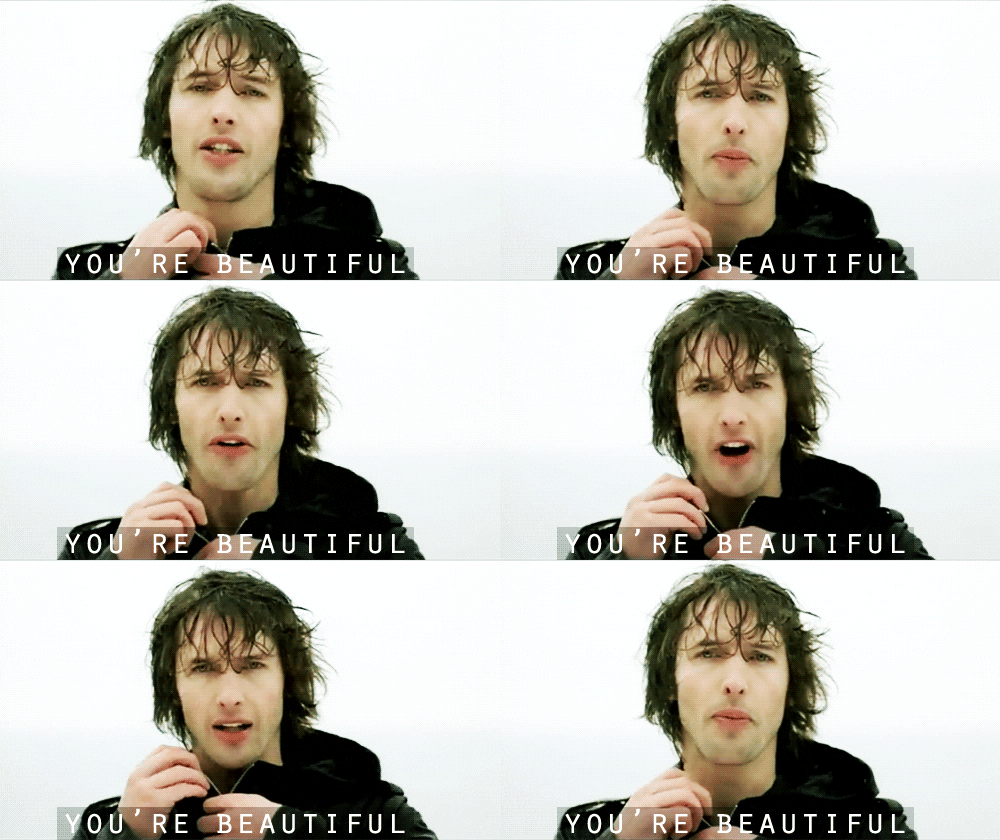
Hey Beautiful

The first time I was called "beautiful" took me by surprise. It is a simple word but we put a lot of stock in beautiful. Even those lacking vanity still seem to reserve the word for describing nature and the majesty of God. It was silly for it to have an impact on me at the time. It had come from a young girl with a childish crush out of the blue. However, it was meant sincerely and I knew that it was the first time that word had been used in my direction, so of course it struck me. 


Of course, others in my life had called me handsome, good looking, etc., but the actual word beautiful not so much. Reflecting on it, the reason it probably stuck with me, is because I have always had self-image issues.
Growing up with big glasses, one of the only Hispanic kids, and weird/nerdy; kids always teased me about one thing or another in school about my looks. We hold on to a lot of crap from childhood well into adulthood. Take that childhood funk and add on a missing limb and scars everywhere, and "distorted body image" doesn't begin to cover it.

Body Image

We develop these self-inflicted body image standards from various places; family, other people, and of course the bombardment of media (everyone's favorite scapegoat). It really is amazing what your brain will pick up on even if it is just inference.
Caution: I have very strong opinions on body image. Part of my job at a K-12 school is taking pictures with the yearbook group. Kids develop these self-images earlier and earlier. I will never forget the heartache of a 5th-grade girl asking if I can use photoshop to make her prettier. It broke me, I leaned in and showed her the review screen on the camera and said, "Look at that, that's such a good picture. I can't improve on a picture that's already pretty." She gave me a half-hearted smile and seemed content. Dress codes is another sore spot for me because it is unbelievably skewed against girls. Modern dress is so messed up in the way clothes are marketed to one body type and girls that don't fit that often find themselves in the predicament of feeling good about themselves or possibly getting in trouble. Ok, I am off on a rant. It's over. Point is, I see how children distort their own body image because of other children and even adults that mean well.
 I have taken note recently of a trend in media archetypes when it comes to amputees. Of course, I am about to shatter the glass for some, meaning this is something you dismiss of write off because you just don't notice it until someone points it out. Before I move on, I am well aware that amputees are not the only or first group to experience this type of typecasting when it comes to TV and film.  This is how we got, the Asian Nerd, the Token Black Guy, the Gay Best Friend, and whatever Brenden Fraser was trying to be at the time.


Bad, Dirty, or Hidden

Plain and simple. According to mainstream media, amputation are the result of bad choices, bad guys make. Take most action film villains with amputations. In this version of conditions, no one asked for, directors will allow you to find the villain attractive but that amputation means they are bad in some way.


These villains from Kingsman and Logan were considered cool and good looking but we have yet to have that in a good character, which brings me to the next.

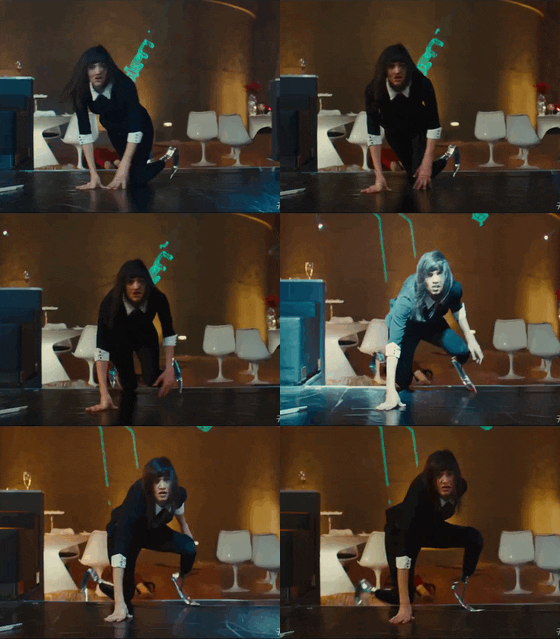
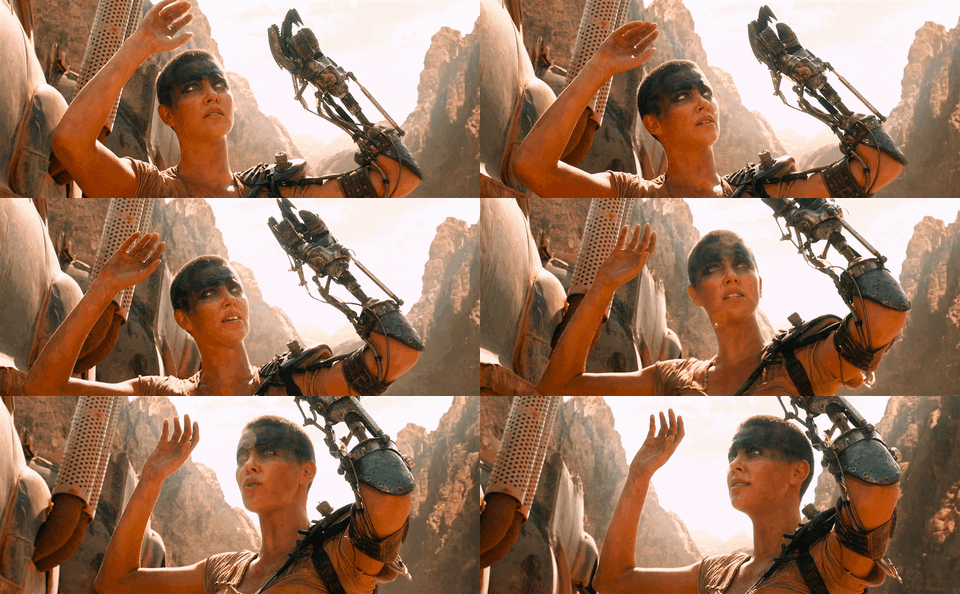
Films still have a thing about dirty people, maybe it is something biblical about lepparse and such being unclean but this is a big one too with amputees. Good characters are often shown as amputees that are dirty. Furiousa from Mad Max Fury Road was dirty and grimy even though she was surrounded by clean beautiful women.

One of the most famous film amputees was not shown as a clean while human until her got new legs and looked "normal" on screen. Good ole Lt. Dan, granted he was supposed to be a representation of disabled and homeless American Veterans but even when he wasn't doing drugs or hookers he was still messy.


Now while those mentioned before at least give amputees representation other directors will just straight up hide it. I am looking at you Hunger Games.


In the books, Peeta's missing limb was a big plot device. It is why they have trouble outrunning the flesh eating rain, it is one of the ways Katniss knows he is the real Peeta to name a few major things. In the film, doesn't exist. I often feel the directors felt he couldn't have been a mainstream love interest with such a thing. Not to pick on Hunger Games but the Fault In Our Start film glazed over Agustus amputation. This one got to me most because Gus's missing limb is related to his cancer like mine.

This is not a notion that is restricted to just these types of movies. Children's films do it too, take Disney's forgotten gem, Treasure Planet.

In the end, Mr. Silver does become a redeemed character but his prosthetics are literally his bad guy identifier. "Beware the Cyborg"
Luckily someone noticed and made a cool story about a pair of amputees.


Show a Little 

Ok so on to the point of this blog. I have days where I say to myself "I could never be good looking, I'm not even a whole person" and other days "come on cool robot leg, let's go kick the world in the pants and look good doing it" Cancer took that from me, which has made me hyper aware of how we treat others. Even just staring is No Bueno for a lot of people. It actually makes me mad when people stare as adults, where kids don't mind asking.  Body image is something adults need to take better care of when it comes to setting examples for children. I have seen the hurt it causes.

If you are still with me, please don't tell me I am good looking for beautiful in comments. Instead, I want you to take this as a notice to tell people you see every day that you like something about them. Tell someone you may have never said it to, "you're beautiful" It can mean the world to them, and that can mean changing the world.


Sunday, March 19, 2017

Cancer and the Card

You and Everyone Else

Today I checked in at the patient hotel attached to MD Anderson for check-ups and test. We got a late start which put us here very late. We missed the dinner, and there is currently Houston's big rodeo going on, so we didn't want to venture out to avoid more traffic. Thank God for Waitr. For those who have never used Waitr, it is an app service that allows delivery from certain restaurants. We decided to meet the driver in the lobby just to avoid any trouble with the hotel allowing him up to the room. There was a big loud person at the front desk, a lady screaming at the security guard because the security guard helped another guest first. This lady says, straight face, "I can't handle you being rude, I've had a rough year!" This was enough to get me to turn around and take note. This lady seriously tried to pull the cancer card on the security guard here. One thing about the cancer card, it doesn't work at a place like this. I really wanted to look at her and say, "You and everyone else here at the cancer hospital!" It's not a competition to beat others at having cancer, if it was, I'd forfeit gladly.


Now I don't know this lady's situation, she may have been going through this the first time, alone, or something but she needed to understand that she is making a high-stress situation harder on everyone because she isn't getting her way. For the record, the was demanding the hotel move her room because she doesn't like being by an elevator or ice machine, in a fully booked hotel. The manager was being gracious and told her while they try to consider every request, at times they can't always fill all of them. (Something to consider, quite a few people scheduled their appointments to coincide with the rodeo. It's not my thing, but if ever there is a concert I want to see in Houston, I might do the same.)

Empathy is an Art

We as human beings tend to be very good at sympathy, but empathy is far less easy for most. The general rule most people follow is to try to "Me Too" as empathy. While relating is part of empathy people usually come off as one-upping with this approach.


Now that I have been in this situation, I find that being understanding is the best approach for empathy. It is the method I like. I have a co-worker that is a pro at this approach and it has made me very comfortable sharing my experience with her. I know talking about chronic illness is often uncomfortable, but it is always good to remember that people are allowed to feel that their crap is soul crushing even if it seems little in the grand scheme. I try to practice this often as a teacher, students feel like their life is over with a bad grade or a difficult relationship and while I often want to tell them it doesn't matter in the grand scheme, that is their view of their world so it is breaking to them. Side note on this, there is a fine line most teeter on where feeling crushed and over exaggerating meet. Don't cross that line.

The Cancer Card

One tool of causing instant empathy I learned about six years ago was the Cancer Card. Kenny, the man who makes my prostheses and has been my mentor on the whole thing, being an amputee himself has advised me to play the Cancer Card or Disability Card when needed. His thinking is that having a disadvantage gives you the ok to turn something into an advantage. I do if needed but I don't always because I know there are many who abuse these sorts of things. See Also: Disney Disability Pass. The one I have never done but should is plane boarding early for disability instead of paying for early boarding. 


Like the lady today should have known, there are some places you just can't play the card. I get it though, she is used to it working. That in mind, I do ask that you consider others that do play it. Sadly we live in a world where dishonesty goes unchecked. As a caring human being, it hurts. It hurts that times I feel like I can't or shouldn't help someone in need because there are those that aren't really in need and are just looking for an easy way. 
I promise to only play my Cancer Card when I feel like my illness really is a hindrance to a task or event. I trust in you all to keep me accountable but also be empathetic when I need it. It is a lot to ask but I hope through these writings I am making an effort to help you all undersant my plight and in turn know that others need a little empathy too.


Thursday, February 2, 2017

Cancer and the LDR

Going the Distance


In some of our dating careers, we have tried the Long Distance Relationship (LDR). As a high school teacher, I am learning that this is more commonplace than it was even in my day. Movies always showed young love torn away by parents jobs or summer camp.


Now, many young people develop meaningful relationships with people they have never met face to face through a shared interest and the internet. Those friendships can become more in some cases, and thus the LDR begins. Now they have ways to be in constant contact with one another and other than physically being able to reach out to that other individual these can be a substantial relationship.

Not For Me


I was never one that ever thought I could make an LDR work in any way. As a high school student myself, I hated talking on the phone. I still do! It is why I LOVE texting and other typing ways of talking. I also never got the concept of why a girl would want to just have me on the phone when I had nothing to say. I would lie next to my dog if I needed to hear breathing in my ear.


Inevitably I was forced into an LDR when my first college girlfriend went out of state. We made it work a while. We both complained about the distance, but in hindsight, we really weren't that far away. However, a lot of the issue was funding for gas money, food, and such. Eventually, it got stale. Later on, in life, we would both admit that having to force time into our busy class schedules just to get a few words in became more of a chore than a joy.

After that, I even ended a subsequent relationship when distance became a part of it because I was certain it would fail anyway. I was certain the LDR was not for me.

Stronger Commitment


My first fight the dragon once again forced me into the old LDR. Tara and I had been married a whole whopping FIVE MONTHS before I started treatment. On top of that, we bought a house only a few days before my initial diagnosis. Without working myself, that left Tara to work just to make ends meet, with the lingering deadline that her contract position would be ending when the year did. She ended up losing the job and immediately took two full-time retail positions to keep us afloat. As I stated before I had my retired father to make treatment trips for me. However, I hurt every moment we couldn't have, even if I was home and she was just at work.

Tara and I spent the next six months doing everything we could to keep a healthy relationship going. After most treatments, I barely had the strength to sit up and stay conscious. I found the will just so I could hear my sweet wife's voice. When I came home I was still weak and tired, she would spend hours in bed with me, reading to me, trying to make me smile with funny shows, deviously allowing the dog to sleep in the bed (which I did not allow before this), and just being there. Tara was my rock, and even though I hate talking on the phone, she was the right person on the other end to make me not give up. This might be shocking to say, but had it not been for her, I wouldn't have fought so hard to beat my cancer. We were both scared that being separated so soon, we might fall apart, especially with the stresses we faced. We made it work, I was an LDR believer.

We felt robbed of our first year together, but it made what we have near unbreakable. I had mostly recovered by our first anniversary, and we decided then, eating our year old cake topper trying to enjoy it for the other's sake, we beat some crazy odds. One year felt like a lifetime. Now we get to make a life time feel like an eternity.